Most force does not come from effort. It comes from position. It comes from where awareness is operating when experience arrives.
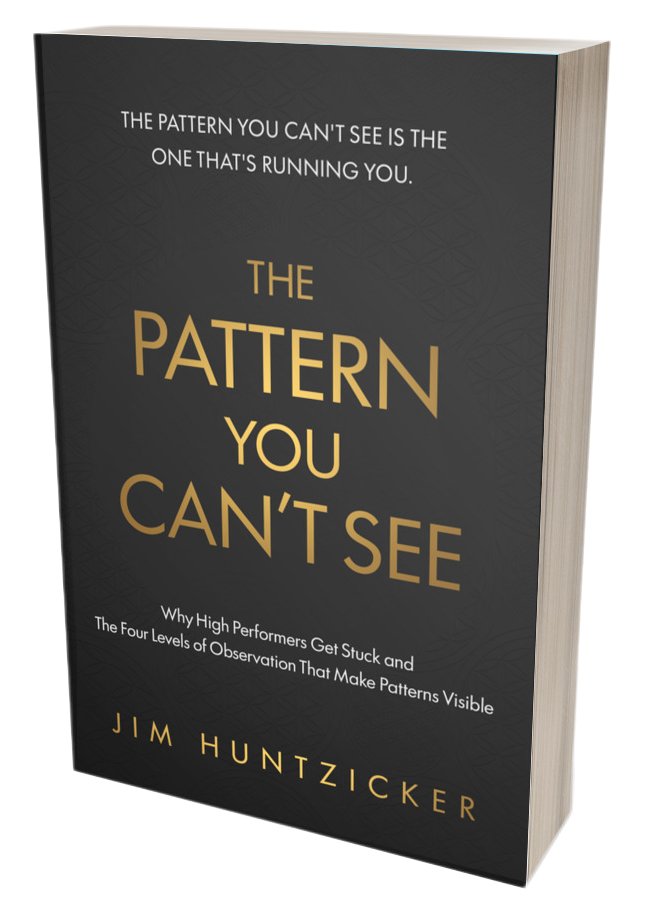
The Observer Continuum maps four distinct positions. Not personality types. Not developmental stages. Positions. Vantage points that every person has operated from at different moments, though most spend the majority of their time in the first two positions without recognizing them as positions at all.
What shifts across these positions is not the content of experience. Thoughts still arise. Emotions still move. Circumstances still change. Action still happens. What changes is whether those experiences are inhabited or observed. Whether they feel like who you are, or like what is happening.
That distinction determines whether force becomes necessary, whether patterns remain invisible, and whether clarity holds under pressure.
You don’t outwork patterns.
You out-observe them.
Where Patterns Stay Invisible
Most people operate from a structural collapse between awareness and experience.
Thought feels authored. Every internal narrative feels like you. What begins as a passing thought becomes truth or identity.
Emotion becomes identity rather than information moving through the system. Anger is not something being experienced. It becomes who you are in that moment. Anxiety is not observed. It defines the state.
Circumstances turn into self definition. Success becomes proof of worth. Failure becomes evidence of inadequacy. Outcomes carry more weight than the situation requires because identity is attached to them.
When awareness collapses into thought, emotion, and outcome, the structure organizing perception remains unseen. What remains unseen organizes automatically.
THE FOUR POSITIONS
Level 1. Unconscious Identification
Awareness is fully merged with experience.
Thoughts are believed rather than noticed.
Emotions become identity rather than sensation.
Circumstances define rather than inform.
There is no space between what happens and how you respond. Reaction is automatic. Justification follows. What feels like decision is often compulsion explained after the fact.
Force becomes the only available tool. Not because something is wrong, but because observation is unavailable.
Most people operate from this position under pressure without recognizing it as a position at all.
Level 2. Conscious Identification
Patterns become visible. Distance does not.
You can name the anxiety before the board presentation. You can explain the control reflex. You can predict when the reaction will appear.
And when pressure rises, it still runs.
This is where most personal development operates. Insight increases. Language improves. Behavior may improve in calm conditions.
But awareness has not relocated.
Understanding does not change position. The pattern is described from inside itself.
The frustration unique to this level is watching yourself participate in what you can clearly see. That frustration is not regression. It is proximity. You are close enough to recognize the pattern, but not yet far enough to stand outside it.
Level 3. Active Observation
Awareness gains functional distance from experience.
A gap appears between what happens and what follows. Not through discipline, but because awareness is no longer fused with content.
From that gap, response becomes available as something distinct from compulsion. Thoughts are seen without being believed. Emotions move without dictating behavior. Patterns that once operated automatically become visible.
Once visible, their authority weakens.
Aligned decision-making becomes structurally possible because perception is less distorted. Force decreases in direct proportion to how clearly the pattern can be seen.
The system is no longer working against itself.
Level 4. Pure Observation
Awareness is no longer identified with thought, emotion, or outcome.
Engagement remains complete. Stakes remain real. Decisions still matter.
What changes is that identity no longer depends on what is happening. The distortion introduced by self reference is absent. Intelligence operates without internal negotiation.
Patterns lose authority not because they are fought or replaced, but because they are no longer mistaken for identity.
Recognition alters the structure.
No force required.
No technique needed.
The Structural Shift
When awareness moves from I am the experience to I am aware of the experience, position changes.
When position changes, the consequences that follow from that position change with it.
Force does not disappear because someone tries harder to eliminate it. It dissolves when the identification that made force necessary is no longer operating.
The mechanism is structural.
That is what this framework maps.
Applying This Under Pressure
Understanding the continuum conceptually is one thing. Operating from observation when stakes are high, when patterns fire fastest and perception narrows, is another.
TruePath provides real time decision diagnostics that identify which position awareness is operating from during high stakes moments. Not to manage behavior, but to reveal position.
When position becomes visible, distortion decreases. Signal clarity improves. Decisions resolve with less internal negotiation. Force becomes structurally unnecessary because the condition that required force is no longer present.
This is not mindset work.
It is decision infrastructure.
Observation restores the vantage point from which clarity was always available.
Once that position becomes visible, patterns reorganize automatically.
No force required.