Most force does not come from effort.
It comes from the position awareness is operating from when experience arrives.
The Observer Continuum maps four distinct positions from which awareness can relate to thoughts, emotions, patterns, and circumstances. They are not personality types, developmental stages, or levels of achievement. They are vantage points, and awareness can move between them within the same day, the same conversation, or even the same decision.
What changes across the continuum is not the content of experience. Thoughts still arise. Emotions still move. Circumstances still change. Pressure still exists.
What changes is the relationship awareness has to what is happening.
When awareness is identified with experience, the experience becomes the position from which perception and decisions form. When awareness is observing experience, the pattern can be seen rather than simply operated from.
That distinction determines whether force becomes necessary, whether patterns remain invisible, and how much distortion enters a decision before analysis even begins.
The position awareness operates from determines whether force or clarity is running the system.
WHERE PATTERNS STAY INVISIBLE
Patterns are difficult to see for a simple reason.
You cannot see clearly what you are operating from inside of.
A thought arises and feels like truth rather than something occurring within awareness.
An emotion appears and becomes the position from which the situation is interpreted.
An outcome stops being information about what happened and begins carrying meaning about who you are.
None of this requires conscious choice.
Under pressure, the merger can happen before deliberate thought has much of a role. Fear, anger, anxiety, stress, uncertainty, or the familiar tightening around a decision can appear automatically. The response feels appropriate to the situation because the position shaping that response is invisible from inside it.
This is why highly intelligent, self-aware people can understand their patterns in detail and still repeat them.
The issue is not lack of insight.
It is proximity.
THE FOUR POSITIONS
LEVEL 1: UNCONSCIOUS IDENTIFICATION
At Level 1, awareness is fully merged with experience.
Thoughts are believed rather than noticed.
Emotions become identity rather than experiences moving through awareness.
Circumstances are absorbed into self-definition.
There is little or no visible distance between what happens and what follows. Reaction occurs automatically. Explanation and justification may come afterward, but the response has already begun forming.
From inside this position, force feels necessary because there is no visible alternative to the pattern generating it.
A leader receives criticism and immediately begins defending the decision.
A founder sees revenue decline and tightens control across the company.
An entrepreneur feels uncertainty and experiences an immediate pressure to do something, resolve something, or regain control.
From the inside, each response can look completely rational.
That is what makes Level 1 difficult to recognize.
The pattern does not feel like a pattern.
It feels like reality.
LEVEL 2: CONSCIOUS IDENTIFICATION
At Level 2, the pattern becomes visible.
Distance does not.
You can recognize the anxiety before the board meeting.
You can name the control reflex.
You can explain the origin of the conflict avoidance.
You may even know exactly when the pattern is going to appear.
And when pressure rises, it can still determine what happens next.
This is where many capable, self-aware people become frustrated. They understand what they are doing while they are doing it, yet understanding alone does not stop the pattern.
The insight is real.
The position has not changed.
Awareness is describing the pattern while still operating from inside it.
This is the difference between knowing a pattern exists and seeing it from outside the position that made it compulsory.
Level 2 is not failure or regression.
It is what identification looks like after self-awareness has developed.
LEVEL 3: ACTIVE OBSERVATION
At Level 3, awareness gains functional distance from experience.
Thoughts still occur. Emotions are still felt. Pressure can still appear.
But they no longer have to become the position from which the next decision forms.
A gap becomes available between what happens and what follows. Not because the reaction is being suppressed or managed, but because awareness is no longer completely fused with it.
The familiar tightening may appear.
The defensive thought may appear.
The impulse to control may appear.
But the appearance of the pattern and the action that follows are no longer the same event.
This is where recognition begins.
Recognition is not a better explanation of the pattern. It is the shift that occurs when awareness is no longer operating from inside it.
The pattern becomes visible as content within awareness rather than remaining the vantage point from which awareness is operating.
That change in position makes something possible that insight alone could not provide:
The pattern can appear without automatically deciding what happens next.
LEVEL 4: PURE OBSERVATION
Level 4 is not a state to achieve or a position to maintain.
At Level 3, awareness observes experience from a position of distance. There is still an observer maintaining some separation from what is being observed.
At Level 4, that structure simplifies.
Awareness is no longer positioned against experience in order to observe it. Experience unfolds within awareness without identity depending on what appears.
Thoughts still arise.
Emotions still move.
Decisions still matter.
Responsibility remains.
What changes is that nothing occurring within experience has to become self-definition.
Success does not need to confirm identity.
Failure does not need to threaten it.
Criticism does not automatically require defense.
Uncertainty does not automatically require control.
This is not detachment, passivity, or withdrawal.
Engagement remains intact.
What decreases is the internal negotiation created when identity becomes involved in what is happening.
The pattern may still appear.
It simply no longer holds the same authority.
THE STRUCTURAL SHIFT
The central movement across the Observer Continuum is from identification to observation.
From:
I am the experience.
To:
I am aware of the experience.
That distinction sounds small until pressure arrives.
When awareness is identified with the pattern, the pattern organizes perception before the situation has been fully evaluated. It determines what feels threatening, urgent, necessary, or true.
When awareness is no longer operating from inside the pattern, the same thought, emotion, or impulse can still appear without automatically determining action.
Recognition does not erase conditioning.
It does not guarantee that a pattern never appears again.
It changes the relationship awareness has to the pattern.
Before recognition, the pattern is the position.
After recognition, the pattern can be seen from a different position.
That is the structural shift the Observer Continuum maps.
WHY THIS MATTERS UNDER PRESSURE
The value of the Observer Continuum is not philosophical.
It becomes visible in decisions.
Pressure narrows perception most when the stakes are real. A revenue decline. A difficult hire. A partnership decision. Conflict inside the leadership team. A board challenge. A strategic exit.
The intelligence available to the leader may be unchanged.
The information may be unchanged.
What changes is the position from which that information is being evaluated.
When awareness is identified with proving an outcome, protecting reputation, maintaining control, avoiding conflict, or resolving uncertainty, those pressures begin shaping the decision before analysis starts.
The analysis can still be intelligent.
It is simply taking place inside a frame that has already been distorted.
Observation changes what becomes visible because the frame itself can now be seen.
The goal is not to remove emotion, eliminate pressure, or produce perfect decisions.
It is to reduce the interference entering the decision before evaluation begins.
This is not performance optimization.
It is distortion reduction.
WHERE TRUEPATH COMES IN
The Observer Continuum is the map.
The Decision Diagnostic is how TruePath examines real decisions through that map.
The work focuses on decisions where pressure is already present and where the leader’s normal intelligence, experience, and analysis have not produced clarity.
The examination looks at five domains:
Locating the Decision
What is actually being decided?
Revealing the Pattern
What structure is operating?
Revealing the Pressure
How is that structure announcing itself?
Revealing the Position
What relationship does awareness currently have to what is happening?
Revealing the Conditions
What remains when the pressure, pattern, and identity implications are no longer confused with the conditions themselves?
This is not a formula for making the right decision.
It does not replace judgment, strategy, analysis, or expertise.
It reveals where distortion may already be entering the system before those capabilities are applied.
Because sometimes the problem is not that you need another framework.
You are already exceptionally good at figuring things out.
The problem is that you are trying to figure something out from inside the pattern shaping what you can see.
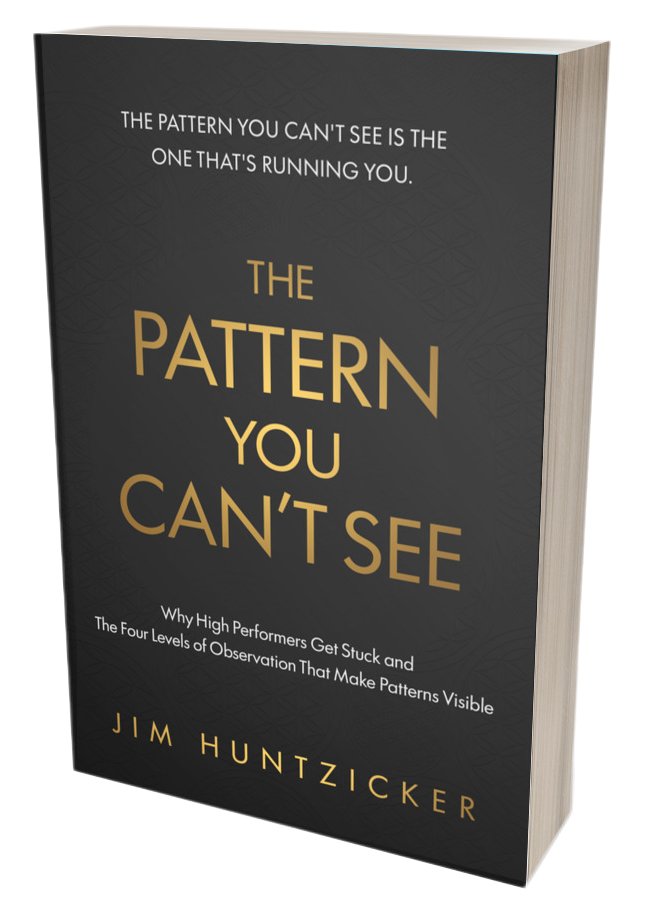
THE PATTERN YOU CAN’T SEE
The patterns that constrain capable people are often not hidden because they lack self-awareness.
They are hidden because awareness is operating from inside them.
That is why more intelligence can tighten the loop.
More analysis produces better explanations.
More discipline produces more refined management.
More effort produces more force.
But none of those necessarily change the position from which the pattern is being experienced.
The Observer Continuum makes that position visible.
Because the pattern does not need to disappear before something changes.
It only needs to stop being the position from which you decide.
Explore The Decision Diagnostic →