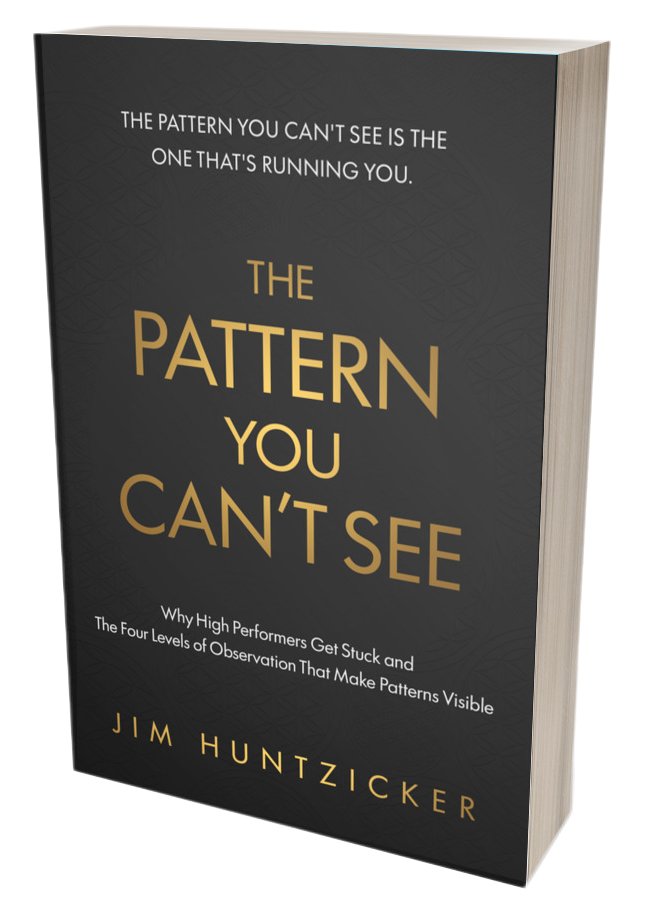
Most patterns do not announce themselves as patterns.
They announce themselves as reactions.
The anxiety that appears before a difficult conversation.
The anger that arrives faster than the situation seems to warrant.
The tightening that shows up around a decision before you have fully evaluated it.
The urge to control, explain, withdraw, fix, delay, or resolve something immediately.
From inside the moment, these responses usually feel like reactions to what is happening.
Sometimes they are.
Sometimes they are also signals that a pattern is already operating.
Not all patterns are harmful. Many are useful, adaptive, and responsible for some of the results you’ve created. The issue begins when the pattern continues organizing perception and behavior automatically instead of being something awareness can see.
You Don’t Have to Know Where It Came From
You don’t have to know where a pattern came from to notice that one is operating.
A pattern may have formed in childhood. It may have developed through repetition, success, failure, relationships, or years of responding to similar situations in the same way.
Sometimes the origin is obvious.
Sometimes it isn’t.
The origin can provide useful context, but it is not required for the pattern to become visible.
You do not need to go digging through old wounds, recover every memory, or build a complete explanation for why the response exists.
The pattern is already showing itself in the present.
The history can explain the pattern.
The present reveals it.
Look at What Happens Automatically
The clearest signal is often automaticity.
Something happens, and the response appears before deliberate thought has had much of a chance to participate.
Fear.
Anger.
Anxiety.
Stress.
Uncertainty.
A tightening in the body.
A sudden need to do something.
A strong impulse to defend, control, avoid, prove, fix, or resolve.
The important distinction is that the emotion itself is not necessarily the pattern.
Fear can be appropriate.
Anger can be appropriate.
Anxiety can reflect real uncertainty.
The signal is in the speed and automatic quality of the response.
It arrives before the reasoning.
Then the reasoning begins explaining why the response makes sense.
When the response arrives faster than the reasoning, the pattern preceded the moment.
The Pattern Is Not Always the Feeling
The emotional response is often the way the pattern announces itself.
The pattern itself may be underneath it.
A leader feels anxiety before delegating an important decision.
The anxiety is real.
But the deeper pattern may involve control, responsibility, fear of being exposed, or an identity built around being the person who always gets it right.
A founder becomes angry when a team member challenges a plan.
The anger is real.
But the pattern may involve competence, authority, judgment, or what disagreement seems to imply about the founder personally.
Someone delays a decision for weeks, telling themselves they need more information.
The uncertainty is real.
But the pattern may be organizing the need for certainty long before the analysis begins.
The feeling is what appears on the surface.
The pattern is the structure already shaping what the moment seems to mean.
Where Do Limiting Beliefs Fit In?
If you’ve spent time in personal development, you’ve probably heard the term limiting beliefs.
A limiting belief is content. Identification is the relationship awareness has to that content.
Beliefs can absolutely be part of a pattern.
A belief such as I have to stay in control, I’m only as good as my last result, money causes problems, or success isn’t safe can shape how a situation is interpreted before conscious evaluation begins.
But the Observer Continuum makes a different distinction.
The belief itself is not necessarily the problem.
You can identify a limiting belief, understand where it came from, and even recognize that it may not accurately reflect the situation in front of you while still reacting from inside the pattern organized around it.
That is why replacing one belief with another does not address the entire structure.
The question is not only, What do I believe?
It is, What is my relationship to the belief when it appears?
Is the belief something occurring within awareness?
Or has it become the position awareness is operating from?
That is the difference between examining the content of a pattern and seeing the position from which the pattern operates.
Knowing the Pattern Doesn’t Mean You’re Outside It
There is another reason patterns can be difficult to recognize.
You may already know exactly what yours is.
You know you tighten control under pressure.
You know you avoid conflict.
You know you overthink decisions involving money.
You know you become defensive when your judgment is questioned.
You may even know where the pattern came from.
And when the stakes become real, it still runs.
That does not mean you failed to understand it.
It means understanding a pattern and observing it from outside the position that made it compulsory are not the same thing.
Insight can describe a pattern while awareness is still operating from inside it.
That is why sometimes even the pattern you can see is still the one running you.
What Makes a Pattern Worth Noticing
A reaction becomes especially revealing when it carries more weight than the situation itself seems to require.
The email is clear, but you rewrite it four more times.
The decision has enough information, but you keep searching.
Someone questions your idea, and the conversation feels personal before you have evaluated what they actually said.
Revenue dips slightly, and your entire sense of stability changes with it.
A team member makes a mistake, and you immediately feel the need to take back control.
None of these responses proves that a pattern is operating.
But they are places where one may be visible.
The question is not whether the feeling should be there.
The question is whether the response appeared automatically and began organizing perception before the situation was fully evaluated.
Patterns Often Look Reasonable From the Inside
This is what makes them difficult to see.
Control looks like responsibility.
Avoidance looks like timing.
Overthinking looks like diligence.
Defensiveness looks like explaining.
Overwork looks like commitment.
Urgency looks like decisiveness.
The pattern rarely announces itself by saying, This is an old structure running again.
It gives you a reason.
Usually a very good one.
And the more intelligent you are, the better the explanation can become.
The explanation may even be accurate.
What remains unseen is the position from which that explanation was formed.
Seeing the Pattern Is the Beginning
You do not need to fight the reaction.
You do not need to eliminate the emotion.
And you do not need to reconstruct your entire past before the pattern can become visible.
You only need to see what you are looking at.
The automatic response.
The disproportionate pressure.
The familiar tightening.
The impulse that arrives before the reasoning.
These are not necessarily problems to solve.
They are signals.
They show you where something may already be organizing perception before conscious choice begins.
And once the pattern becomes visible, a different question becomes possible:
Am I observing this pattern, or am I still operating from inside it?
That is where the Observer Continuum begins.