For a long time, I thought the problem was somewhere in what I was doing.
The business. The strategy. The decision. The timing. The pattern.
I spent more than fifteen years building businesses, making decisions, changing direction, rebuilding, and trying to understand why certain parts of success seemed to become heavier the longer I sustained them.
I was good at figuring things out.
That may have been part of what made the real problem so difficult to see.
Because every time something felt off, I could find an explanation for it.
And most of those explanations made sense.
What I couldn’t see was the position I was operating from while I was making them.
The Question I Couldn’t Answer
I kept noticing a contradiction.
I could understand a pattern and still repeat it.
I could know exactly what I was doing, explain why I was doing it, and recognize it while it was happening.
And under enough pressure, it could still run.
I began seeing the same thing in other capable people.
Leaders who knew they tightened control when uncertainty increased.
Entrepreneurs who could explain why they avoided certain decisions.
Executives who had spent years examining themselves and still found familiar reactions taking over when the stakes were high.
The issue wasn’t lack of intelligence.
It wasn’t lack of discipline.
And it wasn’t necessarily lack of self-awareness.
Something else was happening.
What I Had Been Missing
The variable was position.
There is a difference between having a thought and operating from inside it.
Between feeling anxiety and having anxiety become the position from which a decision is evaluated.
Between experiencing an outcome and allowing that outcome to become evidence about who you are.
When awareness is identified with what is happening, the pattern does not feel like a pattern.
It feels like reality.
That is why it can remain invisible even to someone who understands themselves exceptionally well.
Insight can describe the pattern.
It does not necessarily create distance from it.
That distinction changed the way I understood nearly everything I had been looking at.
The Pattern Behind My Own Decisions
I grew up around significant financial instability and conflict surrounding money.
There was tension when there wasn’t enough and, later, tension when there was more of it.
Long before I understood business, my system had already formed associations around money, stability, and conflict.
Years later, when my businesses became stable, those old patterns were still present.
I did not consciously believe stability was dangerous.
I wasn’t sitting in meetings thinking, I need to disrupt this because things are going too well.
The decisions looked strategic.
A new partnership.
A new investment.
A change in direction.
A reason to walk away and build again.
What I eventually recognized was that the business was not being evaluated from a neutral position.
The pattern was already shaping what looked true before the strategic explanation arrived.
Intelligence wasn’t freeing me from the pattern.
It was helping me explain it.
What Changed
What changed was not that I learned a better strategy.
It was not that I finally understood the pattern intellectually.
I had been doing that for years.
What changed was the relationship I had to it.
For the first time, I could see the pattern as something occurring within awareness rather than as the position from which I had to respond.
That distinction is what I now call recognition.
Recognition does not mean correctly naming the pattern.
It does not mean understanding where it came from.
It refers to the shift that occurs when awareness is no longer operating from inside it.
The pattern may still appear.
The old reaction may still arise.
But appearing and deciding are no longer the same thing.
This became the foundation of the Observer Continuum.
Why I Built TruePath
TruePath Alignment Advisors exists because I kept seeing the same structural problem in people who were already capable of solving difficult problems.
They didn’t need someone to tell them to work harder.
They didn’t need another motivational framework.
And many of them did not need more insight into the pattern itself.
They needed to see where the decision was actually forming.
Because a decision can be intelligent, well-reasoned, and supported by data while still being shaped by fear, control, identity, urgency, or the need for relief before conscious analysis begins.
That does not make the decision wrong.
It means the conditions under which the decision is being formed matter.
This is the work behind the Decision Diagnostic.
Not telling someone what to decide.
Examining what may already be shaping the decision before strategy is applied.
What TruePath Is Not
TruePath is not built around certainty.
I do not believe there is a method that can guarantee the right decision.
Markets remain unpredictable.
People remain complicated.
Information remains incomplete.
Good decisions can produce bad outcomes, and poor decisions can sometimes produce good ones.
The work is not about removing uncertainty.
It is about making distortion more visible.
When awareness is identified with a preferred outcome, reputation, fear, control, or the need to resolve pressure, perception can narrow before analysis begins.
Observation does not provide an answer from somewhere outside the decision.
It changes the position from which the decision is being examined.
That is a much narrower claim.
It is also the one I can stand behind.
Why This Work Matters to Me
I spent years trying to solve positional problems with intelligence.
The intelligence was real.
The effort was real.
The explanations were often accurate.
And the same pattern could continue underneath all of them.
That is why this work is not about becoming smarter, more disciplined, more spiritual, or more self-aware.
It is about seeing the structure clearly enough that the pattern no longer has to remain the position from which you operate.
That is the work behind TruePath.
That is the Observer Continuum.
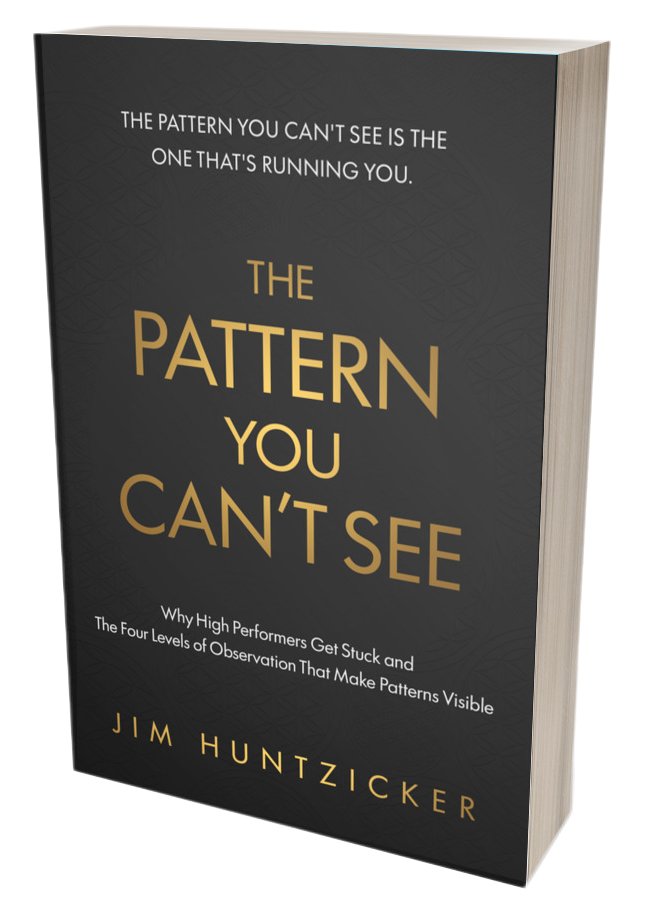
And that is the argument at the center of The Pattern You Can’t See.
The pattern you can’t see is the one that’s running you.
And sometimes even the one you can see is…
— Jim Huntzicker
Founder, TruePath Alignment Advisors
Where to Begin
If you want to understand the framework behind this work:
Or, if you want to see how it applies to real decisions under pressure: